
What is a hernia?
Hernia = hole
A hernia is a hole in the connective tissue in the body. This allows organs from one space in the body to enter another cavity in the body. Not all of these holes are a problem, therefore not all hernias need surgery.
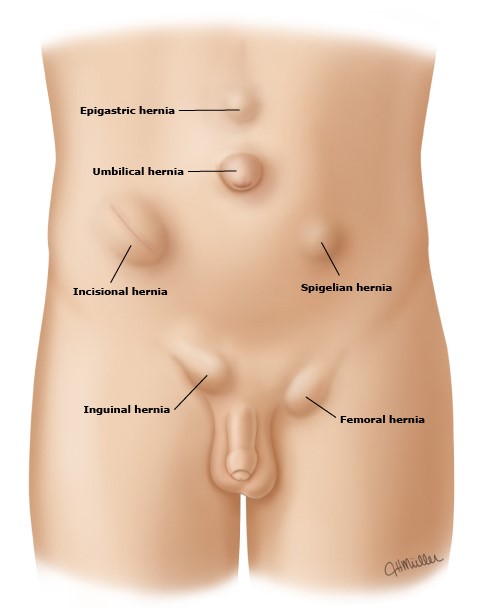
Source: https://www.upstate.edu/hernia/about-hernia/index.php
The most common sites of hernia are:
- Abdominal wall (ventral hernia)
- Belly button (umbilical)
- Groin (inguinal)
- Incisional hernias (sites of old scars)
- Pelvic floor
- Back and flank
What are symptoms of a hernia?
Hernias most commonly are found as a bulge or bump that is new over your abdominal wall or groin area. Other times you may notice new muscular pain or strain along the abdominal wall in a very localized area. This type of pain typically feels worse with heavy lifting and physical activity.
Occasionally a hernia can give you nausea, vomiting or constipation if there are intestines stuck in the hernia. Symptoms can also be nonspecific, making some hernias difficult to diagnose
What surgery do I get for a hernia?
There are many ways to fix a hernia. Hernia surgery is a procedure to close the hole and return the organs to their regular space in the body. Dr. Goodwin can repair your hernia using any of the following techniques:
Minimally invasive (laparoscopic and robot) surgery involves small 1-2 cm incisions where the Dr. Goodwin inserts instruments around the edge of the hernia to suture (sew) up the hole on the inside of the body.
Open surgery involves cutting over the hernia site, and then sewing it closed.
Mesh: some hernias will not close and stay together because the tissues have been stretched out over time and are no longer strong enough to hold sutures.
As a rule, mesh is recommended for most hernias that are over 2 cm to prevent them from coming back.
There are many types and brands of mesh. Many mesh products are made of a fine and flexible polypropylene sheet. If you have specific questions about the mesh products and whether mesh would be recommended for your repair, be sure to discuss this with Dr. Goodwin.
Do all hernias have to be fixed?
- No, not all hernias need to be fixed
- Hernias will not heal on their own, they usually get larger over time
- If you have any of the symptoms above, it is important to see a Dr. Goodwin about your hernia
- If you don’t like the looks of the bump or bulge, you can also have your hernia fixed
What to expect after hernia surgery:
- Most people take 2-4 weeks off work and physical activity after hernia surgery
- You cannot lift more then 10 pound for 4 weeks after most surgeries
- You can walk and go up and downstairs after surgery
- You can shower after surgery
- You should not submerge your incisions in a hot tub, pool or bath for 2 weeks after surgery